You already have one.
A working philosophy for people who build things. Three claims, an instrument for scoring yourself by process instead of verdict, and five doors in — each opening on a problem you already have.
Where this goes, stated up front: most of what follows is Ayn Rand. Sources are credited in place, disagreements included. No part of this page depends on your accepting that in advance.
Status, also up front: this spine essay and the reading list are finished. The audit and the five doors are still being written — they are marked SOON below rather than linked, because a door that opens onto nothing would be the first dishonest thing on the page.
I. THE UNCHOSEN ONE RUNS YOU
You think you got out of philosophy when you chose to make things. Philosophy is the seminar you skipped, the discipline with no shipping deadline, the thing people retreat into when they can't bear contact with reality. You deal in cash flow and churn. You do not have time for metaphysics.
In 1974, Ayn Rand stood in front of the graduating class at West Point — an audience as convinced as you are that philosophy was irrelevant to their work — and made the argument this whole section rests on. You do not get to choose whether you have a philosophy. You have one now. It is your standing set of answers to three questions: What is real? How do I know? What is worth doing? You answer them every day, by action, whether or not you have ever said them out loud. The only choice you get is whether your answers were reached by your own thinking or assembled by accident — from slogans, defaults, fears, and whatever your last three bosses believed.
The unchosen philosophy does not sit quietly. It runs you. Watch it work in a founder's ordinary week. "We're data-driven" — an epistemology, and often an abdication: numbers chosen because they are available, standing in for judgment about what matters. "The market will decide" — a metaphysics and an ethics fused together, and fused wrongly: the market is excellent evidence about demand and worthless as a verdict on your soul, and if you cannot separate those two sentences the next bad quarter will read as a referendum on whether you should exist. "Fake it till you make it" — a borrowed theory of being, in which what you are is downstream of what you can get others to believe. Each of these is a philosophical position. Each was adopted without examination. Each has a failure mode that arrives at the worst possible time, under stakes, when there is no slack left to think.
So the offer here is not "adopt a worldview." You are past that; one is already installed. The offer is an audit: drag the installed one into the light, examine it part by part, and replace what fails inspection with something you chose. What follows is the replacement I use, laid out as three claims with their reasoning shown — including where the reasoning is contested, and where I had to weld together parts from different traditions. You are the inspector. Nothing here is transmitted by authority, because a philosophy of independence transmitted by authority refutes itself in the act.
II. FIRST CLAIM — RATIONALITY IS A VIRTUE, NOT A TECHNIQUE
Every operator believes in "clear thinking." There is an entire industry of it — mental models, decision frameworks, Bayesian party tricks. All of it treats reason as a technique: a tool you pick up when a decision looks hard, and set down when it doesn't. This is the narrow version, and the narrowing is where the value escapes.
Rand's claim is wider and stranger: rationality is a virtue — the primary one, from which the others derive. Not "think clearly when it counts," but a standing commitment: reason as your only source of knowledge, your only judge of values, and your only guide to action. All three clauses matter. Most people who consider themselves rational accept the first, haggle over the second, and quietly reject the third. Knowledge from reason — fine. Values judged by reason? Values, they suspect, come from somewhere else: temperament, tribe, childhood. And action guided by reason, always, under pressure, when the room disagrees? That is the clause that costs something.
Here is the derivation, so you can check it rather than take it. A technique is something you apply when you judge it useful — which means some other faculty is doing the judging, deciding when reason gets invited in. What is that faculty? Fear, mostly. Comfort. The desire to have been right. If reason is a technique, then precisely in the situations where the stakes are highest and your feelings are loudest, the tool gets set down — because the thing deciding whether to use it is the thing it would have overruled. You do not lose companies on the decisions where thinking felt easy. You lose them on the ones where you had a reason not to look. Making rationality a virtue rather than a technique means removing the option to set it down: no consideration, ever, gets placed above your own perception of reality. Not the board's mood, not the narrative you already sold, not the version of you that needs this to work.
Two clarifications, because the word attracts misunderstandings. First: this is not the suppression of emotion. In Rand's account emotions are data — extremely fast summaries of what you value, arriving before you can articulate why. You read them; you do not obey them; you certainly do not deny having them. A founder who feels dread before a board meeting has received information. The virtue is in what he does next: names the value under threat and looks at it, rather than either performing confidence or canceling the meeting. Second: in this tradition rationalism — deducing elaborate castles from floating abstractions, untethered from observation — is not the virtue but a named vice. The whole orientation is outward, at reality. A spreadsheet can be a floating abstraction too, if nobody in the room has talked to a customer.
The strongest objection, in your view and not a footnote: the derivation of the values clause is the weak joint. Rand claims to get from "man's life requires reason" to "your life is the standard of value" — from an is to an ought — and whether that crossing works is the most contested move in her whole system. Robert Nozick took it apart with care in "On the Randian Argument," and the reply from her defenders is real but not decisive. I hold the claim anyway, with the joint exposed: you will find the argument and the counterargument side by side on the reading page, and the door on Rand walks the derivation slowly enough to disagree with in specific places. What I will not do is pretend the joint is load-tested when it is load-bearing.
III. SECOND CLAIM — VIRTUE IS TRAINED ON AFFAIRS, NOT IN CONTEMPLATION
Grant the first claim and an implementation problem appears immediately, and Rand — this is a real gap, not a modest one — barely addresses it. Her novels give you the finished article: Roark, fully formed, integrity already total. She described the ideal man with more precision than any philosopher who ever lived and left almost nothing on how a non-ideal man becomes one. You cannot install "never place anything above your perception of reality" by deciding to have it installed. Ask anyone who has decided, at midnight, with total conviction, to be a different kind of person by morning.
The oldest answer in the Western line is Aristotle's, and it is the load-bearing concept of this whole section: virtue is a hexis — a disposition, acquired the way dispositions are acquired, by repetition under real conditions. You become just by doing just acts, courageous by doing courageous ones. Not insight, training. The knowing is cheap; you can teach the standards of good reasoning in an afternoon, and the student will still reason badly on Thursday, because what fails under pressure is not the knowledge but the disposition to apply it while afraid.
Five hundred years ago, in a tradition with no contact with Aristotle, Wang Yangming reached the same result and pushed it one step further — the step that matters most to you. His phrase is 事上磨练: polish yourself on affairs. Not adjacent to your work, in retreat or in the evenings, but in the middle of it — the negotiation, the hiring mistake, the quarter going sideways is the training apparatus. He meant it literally; he ran a military campaign as a philosophy seminar. And his companion doctrine, 知行合一 — the unity of knowledge and action — supplies the diagnostic this claim needs: knowledge that does not issue in action was never knowledge. It was recitation. If you "know" you should kill the product line and haven't, you do not know it yet; something in what you actually believe is still voting the other way, and the gap is a map of where your real philosophy diverges from your stated one.
This is why the claim says on affairs, not in contemplation — and why this section is aimed at builders rather than readers. It is not that operators deserve philosophy as a lifestyle amenity. It is that a business is the best virtue gymnasium ever accidentally constructed: real stakes arriving weekly, decisions that cannot be delegated to consensus, and consequences that answer back. The contemplative has to manufacture tests for himself. Yours are scheduled.
What you get by welding this claim to the first is something neither tradition supplies alone: Rand's destination with a practice regimen attached, five centuries of technology for exactly the gap she left. Whether that weld holds — the two traditions disagree about something deep, and the disagreement is stated openly where it belongs — is the subject of the Wang door, which is written Chinese-first because the tradition deserves its own idiom, not a courtesy translation.
IV. THIRD CLAIM — SELF-ESTEEM IS EARNED BY PROCESS, NOT BY VERDICT
Now the claim the other two exist to protect, because it is the one that fails first under pressure and takes the person down with it.
A bad quarter arrives. Two questions land at once, wearing the same clothes: was I wrong? and am I worth less? Nearly everyone answers them together — up in good quarters, down in bad ones — and both directions are errors of the same kind. The market is the best falsifier ever built of your beliefs about the market: when it disagrees with your forecast, it is right about demand at your price, and you update at full weight, no appeals to being early. But as a judge of whether you reasoned well, the market is close to worthless — an outcome is your decision quality times timing, luck, and everyone else's moves, at a sample size of one. Good process loses quarters. Coin-flip process wins them. Read esteem off outcomes and you are running your self-respect through a random number generator — which is why the same founder is a genius in March and a fraud in November while remaining, in fact, the same person making decisions the same way.
So the claim, stated with the precision it needs: outcomes are epistemic input at full weight and esteem input at zero. Let the verdict rewrite your beliefs, never your worth. What earns the worth? Rand's answer is that self-esteem is not a mood or a birthright but a judgment you cannot fake — your standing estimate of whether you are competent to live, earned the only way estimates are honestly earned: from evidence. The evidence is process. Did I look at the number I did not want to look at, or manage my exposure to it? Did I own the call, or file it under "the market shifted"? Is there a gap between what I told the customer and what I shipped? Was this week chosen or reactive? Did I make the ask, name the price, say the hard thing? Those questions are answerable without consulting anyone — no market, no board, no Twitter. A person who can answer them well in a losing year has self-esteem with foundations. A person who needs the scoreboard's permission has a mood with a lag time.
And here is the trap that eats this claim, stated before you find it yourself: process-based esteem becomes rationalization the moment "I reasoned well" is unfalsifiable. Memory is an advocate, not an archive. Ask yourself in November whether March-you reasoned well, and November-you will compose a flattering story with the outcome already in hand. The corrective is mechanical, not moral: pre-commitment. Write down what you expect and what would prove you wrong, timestamp it, lock it, and score yourself later against the record instead of the recollection. The divergence between what you predicted and what you remember predicting is the most honest data about yourself you will ever collect.
That mechanism is a page, not a paragraph: the audit — a weekly instrument, pre-commitment in front, five practices and three standards behind it, outcomes quarantined from esteem by the layout itself. It is local-first, requires no account, and exports to markdown. It is the most important page in this section; everything else here is the argument for why you would use it.
V. THE HIERARCHY, AS SHE DERIVES IT
The three claims above are lifted out of a system, and a claim read out of its system is easy to nod at and impossible to check. So here is the whole structure — not as a summary to accept, but as a hierarchy to build. Rand divided philosophy into five branches and treated two of them as fundamental, with the rest derived. Each rung below carries the thing it rests on and the thing that fails above it if the rung is wrong. That second line is the point: a hierarchy has load-bearing joints, which is exactly what makes it testable rather than merely impressive.
What is there — and does any of it depend on me?
Existence exists. Whatever exists is something in particular, with a definite nature. Consciousness is the faculty that perceives what exists; it does not author it. Her name for that ordering is the primacy of existence: wanting a thing to be so is not among the ways of making it so.
How would I know — and how would I know I was wrong?
Her definition is the thing to hold onto: reason is the faculty that identifies and integrates the material provided by the senses. The senses are valid; concepts are built from what you perceive by keeping the essentials and dropping the measurements, which is how knowledge climbs from the perceptual to the conceptual; logic is identification without contradiction. Two clauses make this hers rather than ordinary empiricism. First, reason is not automatic — it is not instinctive, not involuntary, and not infallible. To focus is an act of will, and evasion is the refusal to perform it, which is why being mistaken and refusing to look are not the same failure. Second, reason is not one instrument in a kit that also holds faith, consensus and hunch: it is the whole of the method, and it is man's basic means of survival.
What is worth doing?
Only a living thing faces a genuine alternative — continue or cease — and on her argument it is that alternative which makes values possible in the first place; to an indestructible object nothing could matter. So life is the standard of value: the good is what the life of a rational being requires. Rationality is the primary virtue and the remaining six are aspects of it rather than additions to it.
Her two definitions are what make the rest of this rung mechanical rather than inspirational. A value is what you act to gain and keep. A virtue is the act by which you gain and keep it. Every value therefore has a virtue that pays for it, and the architecture is a set of pairs:
Two consequences worth having. Self-esteem, on her account, has two parts — the standing certainty that your mind is competent to think and that you are worthy of happiness — so it is an estimate, and an estimate answers to evidence. And pride is the virtue that earns it: she glossed pride as moral ambitiousness, the work of earning the right to hold yourself as your own highest value. This is why the third claim of this section is not an addition to her ethics but her own pairing turned reflexively: a value that is definitionally the residue of your own acts cannot be conferred on you by a quarter, a board or a market.
What may be done to me, and by whom?
If each person's own life is the standard, then no one may be made an instrument of anyone else's — force is the thing ruled out. Rights are that principle worked out for people living among each other; government exists to protect them and holds no further mandate; laissez-faire capitalism is the arrangement she took to be consistent with it.
What is art for?
Art is a selective re-creation of reality that makes an abstraction concrete — it lets a conceptual being see a value rather than only define one. What an artist selects betrays a sense of life: a set of implicit judgments about what reality is fundamentally like. Romantic realism was her name for the version she wanted.
Now the three claims of this section can be located rather than merely asserted. The first sits on the seam between 02 and 03: an epistemological commitment doing ethical work, which is precisely why it reads as strange. The third is 03 turned on yourself: Rand names self-esteem among the values her ethics aims at, and says remarkably little about how one is actually built. And the second is not a rung at all — it is a gap inside 03. She specified the destination with extraordinary precision and left the route almost empty, which is the hole Wang Yangming's five centuries of practice are here to fill.
One more thing the map makes visible, and this part is the section's own claim rather than hers. Look at what the four sources at the foot of it agree about. They share no lineage and disagree about nearly everything else, and all four put the acquisition of virtue in the same place: in repetition under real conditions (Aristotle), in the middle of affairs rather than beside them (Wang), through the productive work she calls the central value (Rand), and scored after the act against a record rather than a recollection (the standards). Whatever satisfies all four at once is not a metaphor for the practice — it is the practice. For the people this section is written for, that place is a business. An enterprise supplies stakes arriving on a clock you do not control, decisions that cannot be handed to consensus, consequences that answer back whether or not you were ready for them, and a trail of artifacts your memory is not free to revise. That is the underlying reason the second claim says on affairs and the instrument is a weekly audit rather than a reading list. Business building is not one arena where this philosophy can be applied; it is the most effective apparatus available for pursuing the values and training the virtues that earn them.
There is a condition on that, and it is the reason the claim says building rather than merely working. 事上磨练 puts the training inside the affairs, but it is silent about which affairs — and the 事 is not neutral. Thin matter trains thin dispositions. Work with a known procedure tests your compliance with the procedure. A narrow role exercises one faculty and quietly lets the others atrophy. What the doctrine actually requires is 事 with three properties: enough depth that consequences reach you and cannot be handed onward, enough variety that you are forced across customer, product, money, people and craft instead of specialising into a corner, and enough irreducible complexity that no procedure exists and the hard part cannot be routed around. Creating a business supplies all three at once, and supplies them whether or not you are ready for them. Wang is his own evidence here: the doctrine came out of governing a province and putting down a rebellion, not out of a study. And it closes the loop back to the standards on 02 — significance and depth can only be tested against matter that had some. Thin 事 leaves an audit nothing to bite on.
VI. WHAT THIS IS, AND ISN'T
This is a Rand-centered synthesis, not orthodox Objectivism. It welds Wang Yangming's practice regimen, Alfred Adler's account of contribution, and Nathaniel Branden's psychology onto Rand's epistemology and ethics. The Ayn Rand Institute holds Objectivism to be a closed system — complete as Rand left it, extensible in application but not in content — and by that standard this section is not Objectivism and should not be mistaken for it. The Atlas Society exists over precisely this dispute, and Branden spent his last decades excommunicated from the movement whose psychology he built.
I name this before you find it because finding it yourself, three doors deep, would rightly cost me your trust. You now know exactly what is being claimed: not Rand's authority, but a synthesis I will argue for part by part — with each part's strongest objection stated in the open, in a block that looks like this one. When you see this border again, that is what it means.
Every door in this section follows the same contract. It opens on a problem you already have, in your own language, before any thinker is named. It announces where it is going in its first lines — no covert funnel. It takes its own tradition fully seriously, as an account and not a stepping stone. And it states the place where that tradition collides with the spine, in your view, unresolved where it is genuinely unresolved. If a door ever reads as bait, the readers who detect it are the intellectually autonomous ones — exactly the ones this section exists for. The contract is how the doors stay honest.
VII. THE TEST, AND THE RIGHT TO DECLINE
The success metric for this section is not whether you can name a philosophy. Naming is cheap; recitation is what 知行合一 exists to catch. Someone who can quote Galt from memory but still outsources his self-assessment to the market has acquired the vocabulary and missed the thing. Someone who never finishes Atlas Shrugged but starts, this month, separating epistemic signal from esteem signal — updating beliefs at full weight, worth at zero, against a record he wrote in advance — has received it whole. The test is what shows up in what you do. Score yourself on the audit, not the affiliation.
Last thing, said plainly because most of the people reading this work with me: declining is a legitimate outcome. An offer with an implied cost for saying no is not an offer; it produces compliance, and compliance is the exact failure mode this philosophy names in its own terms — a judgment outsourced to keep a relationship warm. Read the doors, take what survives your inspection, decline the rest, and nothing between us changes. The only outcome this section counts as failure is agreement you cannot derive.
"Man is a being of self-made soul."
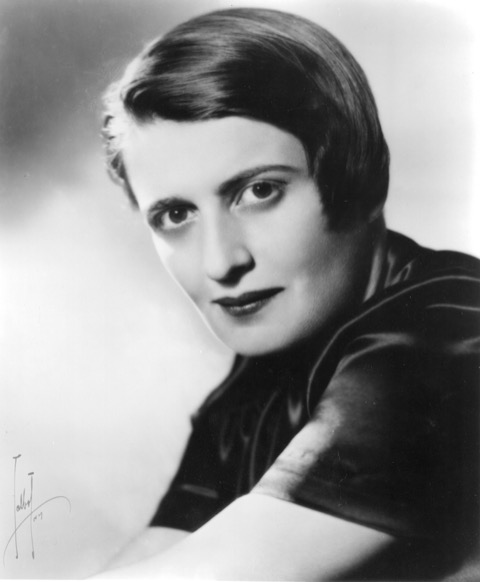
TALBOT STUDIO PORTRAIT, 1943 — THE FOUNTAINHEAD PRESS PHOTO. PUBLIC DOMAIN, VIA WIKIMEDIA COMMONS.
Five doors in
Each is a full account in its own right, and each exits into the same spine. Start where it hurts.